A Living Benchmark for Machine Learning on High-Dimensional Biomedical Tables
NOTE
Authors: Jules Kreuer, Sofiane Ouaari, Julia Hellmig, Julius Braitinger, Nico Pfeifer
Preprint: arXiv:2609.07441
DOI: 10.48550/arXiv.2609.07441
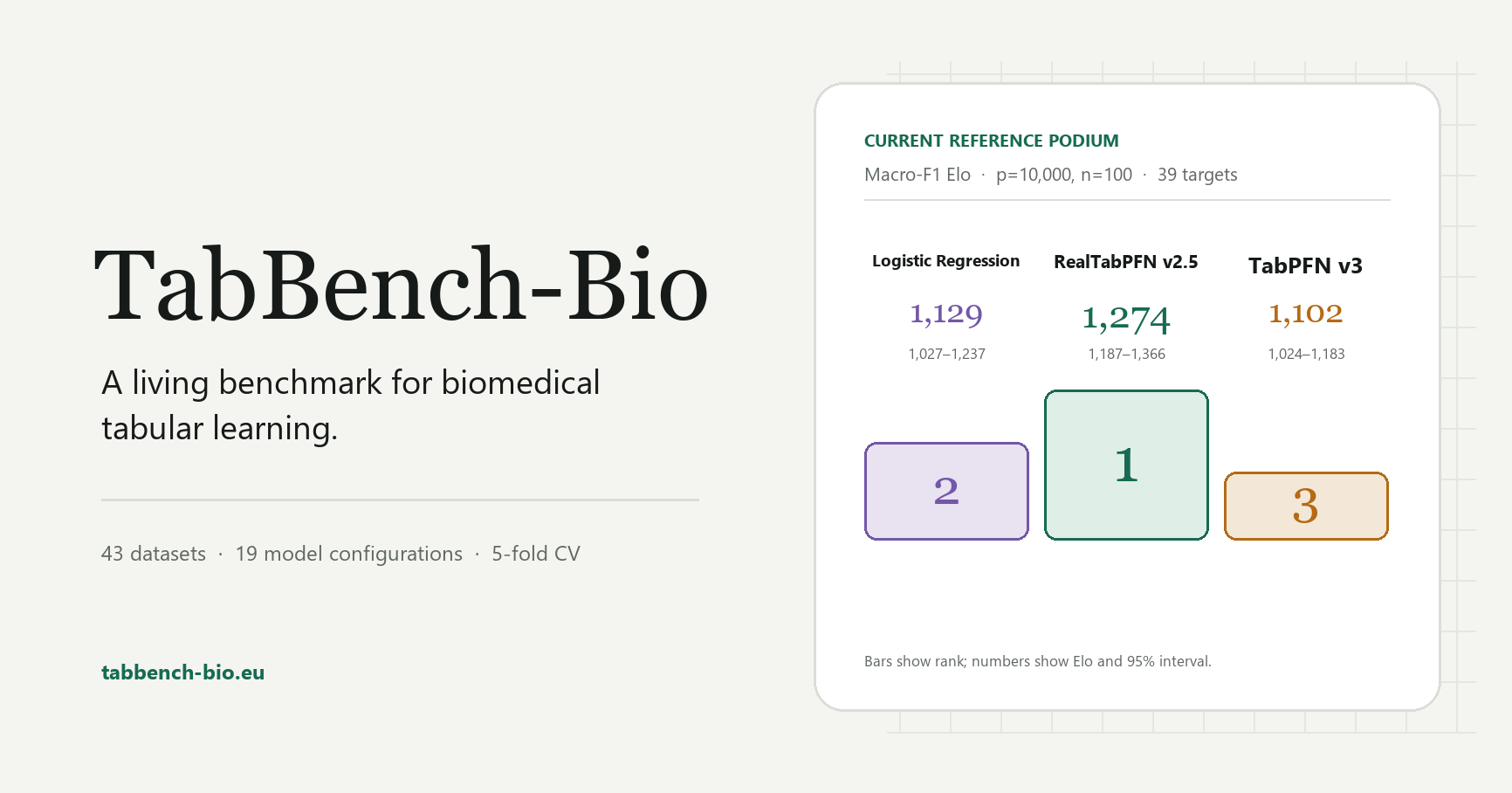
TabBench-Bio evaluates machine learning on biomedical tables with thousands of features and only tens or hundreds of labelled samples. It brings classical estimators, neural networks, and tabular foundation models into a shared evaluation framework.
tabbench-bio.eu /not-a-feature/TabBench-Bio /project/tabbench-bio
Benchmark scope
The benchmark covers classification and regression across transcriptomic, metagenomic, molecular, sequence-derived, and genomic-prediction datasets. A controlled grid varies feature width and training-sample count independently, allowing users to find results for their own data and resource budget.
TabBench-Bio is maintained as a living benchmark, welcoming new datasets and models. The benchmark website provides the latest coverage and results.
Evaluation and reproducibility
Models are evaluated under a shared protocol to support consistent comparisons across datasets and resource budgets. Released results include predictions and evaluation metadata for independent analysis and reproducibility.
Explore performance and computational costs on the interactive benchmark website, or visit the artifact browser for downloadable results. The paper describes the methodology and research findings.
Benchmark your own model
Install the package from PyPI:
pip install tabbench-bioSee the repository documentation for current installation requirements and instructions for evaluating your own model. Contributions of biomedical datasets and model adapters are welcome.
Citation
@article{kreuer2026tabbenchbio,
  title = {TabBench-Bio: A Living Benchmark for Machine Learning on High-Dimensional Biomedical Tables},
  author = {Kreuer, Jules and Ouaari, Sofiane and Hellmig, Julia and Braitinger, Julius and Pfeifer, Nico},
  year = {2026},
  eprint = {2609.07441},
  archivePrefix = {arXiv},
  primaryClass = {cs.LG},
  doi = {10.48550/arXiv.2609.07441},
  url = {https://arxiv.org/abs/2609.07441}
}